EMS – Electrical Muscle Stimulation

What is EMS? EMS is an electronic machines that generates electric current. The electrical currents are delivered through electrodes (usually pads that adhere to the skin) that are placed on the muscles. These currents mimic the action potential coming from the central nervous system, causing the muscles to contract. Theses devices are regulated by the FDA.

EMS can be used for training, therapeutic device, and as a cosmetic tool. Potentially, using these devices can increase muscle strength, diminish fatigue, and tone the body. I have an EMS unit, and I did not experience any of the cons that are mentioned above. However, I am very pleased with the unit, as I found that using it makes me want to exercise much more. After using it my body feels ready to run, jump, cycle, anything! I just feel like I need and want to move and do some exercise.

I decided to buy the Slendertone ReVive S5 Pro Muscle Conditioner & Stimulator. The reason? The price was right (usually sells for $69.99, but lately has been $49.99 on Amazon), and most reviews were positive. I also googled the item and found the company is considered to be reputable.

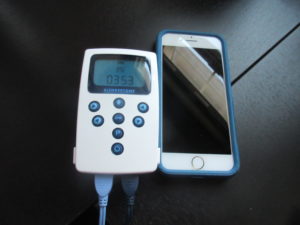
The machine itself is very small. I took a picture of it next to my iPhone 7  so you’d have a better idea of its size:
EMS

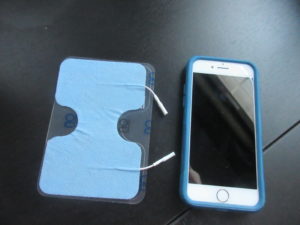
It has 4 electrodes, but you need 2 electrodes to connect to one pad, therefore you can use only two pads, not four. The pads are large and have a very good coverage. The unit has 6 muscle conditioner programs + 99 Intensity Levels:

Program 1: Exercise Preparation (12 minutes).

Program 2: Active Recovery 1 (30 minutes).

Program 3: Active Recovery 2 (20 minutes).

Program 4: Active Recovery 3 (20 minutes).

Program 5: Build Endurance (20 minutes).

Program 6: Muscle Strengthening (20 minutes).

I tried all the programs, and the one I love the most is program 6. The muscles are being contracted nice and strong (I’m now at levels 40-50), and as I mentioned, it makes me want to exercise. Often after a session with my EMS, I hit the treadmill for 30-60 minutes. I just HAVE to move!

It could be that I don’t notice any toning effect because I’m so overweight. It would be interesting to know if you do see your muscles tone the more  you use this device, when you have much less fat tissues.

The unit comes with 4 pads. I’ve had this unit for about a month, and so far the first 2 pads (remember, each pad connects to two electrodes) are holding up very well. They still stick well to my body, and I don’t even need to use an electrode gel. After I finish using them, I simply put the clear film on them, and that’s it.
img_2051

Make sure to read all instructions. They do suggest that you consult with a doctor before starting to use the device, and they also explain very well where on your body you should or shouldn’t use it.

I am very happy with this EMS device, as this is the one thing that physically motivates me the most to exercise!

Exercise

Exercising When You’re Obese

You’re obese, and you want to start exercising. Good for you!

Remember that when you have a lot of extra weight, exercising should be handled a bit differently. Exercise always creates stress for the body, however, if you’re obese your body is already continuously stressed, and it’s best to follow these tips:

Tip #1 – Start Slowly

True, this is a common tip for everyone. But overweight people need to pay extra attention to this and start slower than usual. Us obese people, our hearts already work hard by having to carry around our very heavy body, and our joints are also under daily significant stress. Adding more stress in the form of exercising should be done very gradually. When you start, ignore generic suggestions, and simply do what is manageable for you. Don’t aim for a 30-minute walk, but walk several times a day for 5 or 10 minutes. Do not work out for more than 20-30 minutes a day and do not do too many types of activities all at once.  Introducing one new activity per week is a better idea. Increase the duration/intensity of the workout as you feel more comfortable. If you can easily talk while exercising you are exercising at a comfortable rate. Exercising will become easier for you, both because you condition your body, and because as you lose weight your heart will not need to work as hard for just supporting your body. 

Don’t exercise every day. A good rule of thumb is to exercise 3-4 times a week on alternate days. Exercising will become easier for you, both because you condition your body, and because as you lose weight your heart will not need to work as hard for just supporting your body. Focus first on gradually increasing the duration of exercise. Only then, gradually increase the intensity and frequency of your workouts. 

Tip #2 – Choose the Right Exercise

Choosing a wrong exercise can cause injury, and there’s nothing like an injury to discourage you from continuing your weight-loss program. Many obese people, in addition to other issues that I already discussed above, also have balance issues. Ideal activities would be working out on cross trainers and recumbent bikes, and swimming, all excellent exercises which reduce the impact on joints and lower back. A treadmill is also a good choice, as it is predictable (straight surface with shock absorbers and steady speed), and you can hold on to the rails. The problem is that obese people have a hard time going to the pool, and the exercise machines are found in gyms, another place where most obese people feel very uncomfortable in. If your budget allows, and if you have enough space for it in your home, I would recommend buying a treadmill. It doesn’t have to be fancy with all the bells and whistles, just make sure that it can support your weight. That was the solution I went for, and it encourages me to exercise as much as I can. I put the treadmill in front of the TV, I make sure to record plenty of shows that I like, I turn on the AC, and voilà! I’m all set, and I actually have fun walking several times a day.

No worries if a treadmill, or other fitness equipment, is not an option for you. As mentioned before, you can simply find an activity you are able to do without it being too strenuous. It can be a 5-minute walk about 4 times a day, or moving your arms for a few minutes several times a day.

Tip #3 – Be Consistent

If you’re doing short low-intensity workouts, you might get the feeling that you are not doing much, and that all that effort doesn’t even make any difference. These thoughts can be very discouraging and you might want to quit altogether if you focus on such thoughts and on not seeing quick results. The reality is that moving a little is better than not moving at all. Another reality is that if you have regular workouts, you will improve gradually and be able to handle longer and higher intensity workouts.  

Tip #4 – Do Weight Training

The aerobic ability of obese people is usually not very good. Because an obese person will tire easily doing aerobic exercises, not a lot of energy will be used. Short weight training sessions will enable spending more calories than short aerobic exercises. In addition, weight training will increase the person’s basic metabolism rate, and will improve the looks of a person by increasing muscles’ tone (and possibly also increase muscle mass). Start with doing 8-15 repetitions for each exercise, with 30-60 seconds of rest periods.

Tip #5 – Hydrate and Avoid Heat Exhaustion

Obese people can not adapt to temperature changes as well as other people, and they are more susceptible to dehydration. Make sure to wear light clothing when exercising, and use a fan or A/C if you’re too hot. Drink plenty of water before, during, and after exercising.

Target HR

Target Heart Rate

A common way to determine how intense your workout is, is to measure your heart rate (HR). The faster it beats, the more intense the workout.

In order to determine how fast you want your heart to beat during exercise for optimal weight loss, you first need to calculate your maximum HR. Your maximum HR is what is the maximum beats per minute your heart should beat during exercise. The formula to calculate your maximum HR is 220 minus your age. So if you’re 35, your maximum HR is 185. Please note that this is a simple formula that doesn’t take into account your fitness level. At the bottom of this page, I’ll write the formula for finding your HR zones using your resting HR (the fitter you are the lower your resting HR is).

Once you know your maximum heart rate, you can calculate your desired target heart rate zone — the level at which your heart is being exercised and conditioned but not overworked.


  1. Recovery zone (aerobic): Training at 50%-60% of your maximum HR. In our example, that means 93-111. In this zone, your body will improve its blood flow.
  2. Endurance zone (aerobic): Training at 60%-70% of your maximum HR. In our example, that means training 111-130. In this zone, your body will increase its ability to use fats and carbohydrates, and improves your endurance.
  3. Stamina zone (aerobic): Training at 70%-80% of your maximum HR. In our example, that means training at  130-148. In this zone, your body’s ability to use oxygen and its muscles strength  will increase.
  4. Economy zone (anaerobic): Training at 80%-90% of your maximum HR. In our example, that means training at 148-167. In this zone, your body’s efficiency will improve but it is hard and is recommended only for short period of times.
  5. Speed zone (anaerobic): Training at 90%-100% of your maximum HR, should be performed only by experienced athletes and for short bouts.

Important: If you’re taking high blood pressure medication consult with your doctor to find out if you need to use a lower target heart rate.

If you’re only starting out, start slowly, at about 50% of your maximum HR. You need to gradually build up the intensity as your aerobics abilities improve.


So how do you measure your heart rate while exercising? Many treadmills, ellipticals, etc. offer built-in HR monitors. You just need to hold your hands on the metal handles for a few seconds, and your HR shows up on the monitor. I recommend however that you invest in a good heart rate monitor. The more accurate ones have a separate chest strap that you put around your chest. I prefer the Polar brand, they’re very reliable and easy to use. If you look on Amazon, there are so many models to choose from, such as this one. Just look at the different features (and your budget!) and see what features you think you will use most.


Last but not least, as promises need to be kept, this is how to calculate your workout zones taking into account your resting HR:

  1. Calculate your maximum HR (220 minus your age). If you’re 35, your max HR is 185.
  2. Find out your resting HR: When you wake up in the morning and still in bed, put your index and middle fingers on the artery on your wrist or neck, and count the number of beats in one minute. Alternatively, count how many beats in 10 seconds, and multiply that number by 6.
  3. Calculate your Heart Rate Reserve (HHR): Subtract your resting HR from your maximum HR. If you’re 35 and your resting HR is 65, your HHR would be 120 (185-65=120).
  4. Calculate your Aerobic Training HR Range: Calculate 50% and 80% of your HHR. In our example, you will get 60 and 96 (120×0.5=60 and 120×0.8=96). Now add these numbers to your resting HR. You get 125 (65+60=125) and 155 (65+96=161). This zone (125-161) will give you the zone in which you will burn the most fat.

Why Exercise

Why Exercise


There’s no way around it.  In order to lose weight, we need to exercise and eat less. Sounds simple enough, right? So why is it so difficult??

Let’s admit it, most of us have gone on a diet more than once or twice. Each time we told ourselves that this is the last time, this time we’ll stick with the plan, lose weight and keep it off, for good. We picked the new fab diet, followed the plan’s rules and…. it didn’t last for long!

We keep losing weight only to gain it back, and we actually usually end up with a few more pounds than what we started with.

The answer is that we want to see quick results, we believe the newest celebrity diet is the answer to our prayers. We want to lose weight the easy and quick way. We think that by limiting our caloric intake we’ll lose weight, and that the less we eat the more pounds we will shed, quickly. Unfortunately, that’s not how the human’s body is designed to work.

Our bodies have a very sophisticated mechanism, and I’m referring to our metabolism. When our body doesn’t get enough calories, an “alarm” goes off in our body. The body realizes that it is being starved, and it goes into emergency mode. In this emergency mode the body is trying to get more calories from different sources. The solution that the body finds is to start burning muscle tissues. Each pound of muscle tissue burns 3 times the calories than a pound of fat, so it makes sense to our body to use what gives it the most energy in order to try and maintain the caloric intake our body is used to.

What happens when the body is burning muscle tissues instead of fat? Not only do we not lose fat, our metabolism slows down, and we burn less calories than we did before starting the diet. Our “new” body, now with less muscle mass, finds it harder to deal with the increased calories we are eating again, and stores the excess energy as fat.

This explains the yo-yo effect that I am sure we are all too familiar with. We go on a diet, try to eat very little, our body starts burning muscle tissues, our metabolism slows down, we start “cheating” and eating more and more, and now we’re eating as much as we used to… but with a slower metabolism! It’s no wonder that very quickly we gain more and more weight, and we end up being heavier than before.

The solution is to first of all not eat too little. In order to maintain your current weight, the number of calories you’ll need to eat is: Your current weight X 12 = how many calories you need daily just to maintain your weight. So if your current weight is 200, you will need to eat: 200×12= 2,400 calories per day. If you’d like to lose 1 pound a week, you will need to cut 500 calories per day, meaning, eat 1,900 calories per day. If you’d like to lose 2 pounds a week, you’ll need to cut 1,000 calories from your daily intake, and eat only 1,400 calories per day.


But wait, there’s more! Exercising is the other key element in losing weight.

Exercising will:

  1. Increase the amount of calories you burn
  2. Protect you against muscle loss, especially if you do power training
  3. Help you control your appetite (glucose is released to the blood during exercise resulting in evening the blood sugar level, making you less hungry)
  4. Keep you busy, so you’re not eating out of boredom!
  5. Let you see better result, thus encouraging you to continue and not give up on the process

You can see that there are so many benefits in exercising, so even if you’re perfectly happy being a couch potato, please, do make an effort and try. Just walking a few times a week for 30 minutes will make a dramatic difference.

Burning Fat

Burning Fat


Caloric surplus means that we consume more calories than we burn. The excess calories will be stored in the body as fat, and our weight will increase.

Caloric deficit means that we burn more calories than we consume. If the deficit is too big, the body will compensate and use energy that is stored in the body, either as fat or muscle tissues. An exaggerated deficit can also lead the body to enter an emergency mode, in which the metabolism slows down.

In the food that we eat, there are 3 major groups: carbohydrates, fats, and proteins.  The main purpose of carbohydrates and fats is to provide energy, whereas the proteins mainly build the body and the muscles. Our body uses energy from all these 3 sources of energy throughout the day (including when we sleep).

When we are physically active we use mainly carbohydrates and some fat as energy sources, and sometimes proteins as well. When we don’t have sufficient carbohydrates our body will break down muscle tissues and convert the released amino acids into glucose, which will be used for energy.

When we sleep our body uses mostly fat as energy source.

In one hour of sleep, we’ll consume about 60 calories, out of which 50 come from fat.

In one hour of running we’ll consume about 400 calories (depends on the intensity) out of which about 200 come from fat.

In one hour of a vigorous-intensity activity (such as racing) we’ll consume about 1,000 calories, out of which about 300 come from fat.

We can draw 2 conclusions from these facts:

  1. The more vigorously intensive the workout, the more calories we consume.
  2. In low-intensity activities we use a larger percentage of fat, however, the total amount of fat is larger in high-intensity activities.

Therefore we should try to aspire to work out at the highest intensity that we tolerate. It’s also important to remind new trainees to always start slow and easy.